
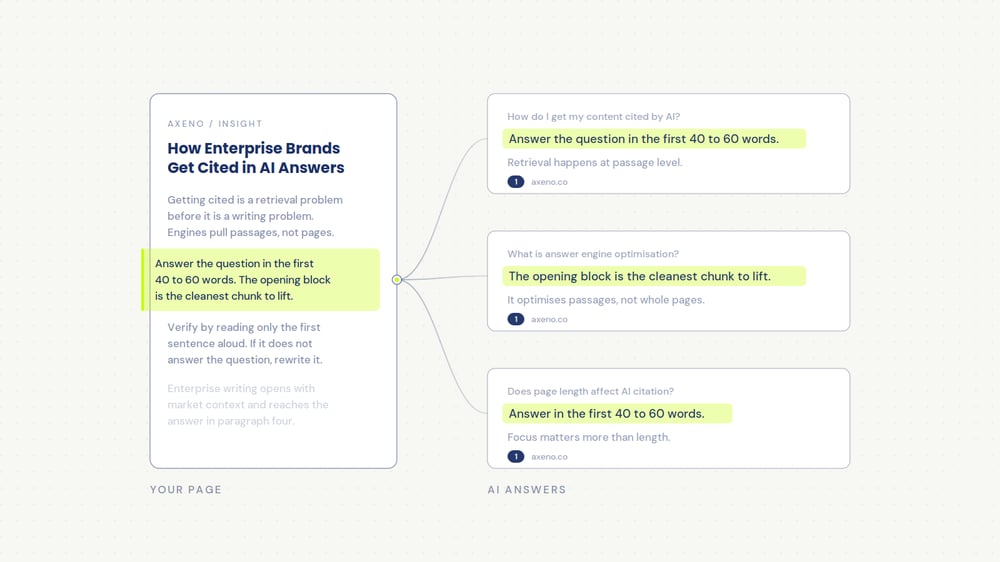
AI answer engines cite pages that are easy to retrieve, easy to extract from, and corroborated somewhere other than your own website. Ranking well on Google still helps, but it no longer predicts citation.
For enterprise brands the fix is structural rather than editorial. Below is the sequence that decides whether your page gets used, the eight items that move the outcome, and how to measure it without buying a tool.
Search position no longer predicts AI citation
- Moz analysed nearly 40,000 queries in February 2026 and found 88% of Google AI Mode citations do not appear in the organic results for the same query. Only around 12% of cited URLs matched the top ten exactly, and roughly one cited site in five appeared in the top ten at all.
- Moz attributes the gap to query fan-out, where one question triggers several sub-queries at once and citations are pooled across all of them.
- Other datasets disagree on magnitude. Semrush reported AI Mode overlapping Google's top ten at roughly 54% at domain level and 35% at URL level, while Perplexity aligned far more closely at over 91% domain and 82% URL. BrightEdge tracking puts AI Overview citations that also rank in the top ten at around 17%.
Treat any single figure as directional. The direction is consistent across all of them: rank is a weak predictor of citation, and the engines retrieving most independently reward it least. Your best-ranked page and your most-cited page are probably not the same page, and most enterprise reporting is not measuring the second one.
How a citation actually happens
Getting cited is a retrieval problem before it is a writing problem.
- Fan-out. One question is expanded into several sub-questions.
- Retrieval. Passages are pulled, not whole pages.
- Selection. Passages are ranked by how well each answers a specific sub-question.
- Synthesis. Retained evidence is rewritten into one answer rather than quoted.
- Attribution. Claims are linked back to their sources.
Selection and absorption are separate outcomes. A page can be listed as a source without shaping the answer, and a page can shape the answer heavily while sitting low in the visible source list. Volume also varies by platform: a 2026 analysis of 602 controlled prompts reported averages of roughly 16 sources per Perplexity answer, 12 for Google AI Overview and 7 for ChatGPT. Breadth of presence matters more on Perplexity; depth and extractability per page matter more on ChatGPT.
The eight-item checklist
Ordered by leverage. Each item carries a verification step, because an unverified checklist is a list of opinions.
- Confirm the page can be retrieved. Check AI crawlers are not blocked in robots.txt, that the answer renders in the initial HTML rather than via client-side JavaScript, and that the page sits outside any form, cookie wall or login. Verify by fetching the URL with JavaScript disabled.
- Give each page one question to own. Retrieval happens at passage level and selection at page level, so a page covering six themes competes weakly against six focused pages. Verify by writing the page's question in one sentence; if you need the word and, split the page.
- Answer in the first forty to sixty words. The opening block is the cleanest chunk a retrieval system can lift. Enterprise writing tends to open with market context and reach the answer in paragraph four. Invert it. Verify by reading only the first sentence aloud.
- Write claims that survive extraction. Models lift sentences out of context, so name the entity instead of saying it, attach every number to its source and date in the same sentence, and avoid pronouns that reach backwards. Verify by pulling five sentences at random and checking each still makes sense alone.
- Publish at least one thing only you can publish. Engines have no reason to cite a page that restates what forty others say, and every reason to cite the only source of a specific figure. Implementation benchmarks, anonymised programme results and client survey data all qualify. Verify by identifying the one sentence on the page that cannot be sourced elsewhere.
- Make the entity unambiguous. Before an engine cites you as credible on a topic it has to resolve who you are, drawing on consistent naming, Organization schema, author credentials and third-party descriptions. Multi-brand enterprises fragment this without noticing. Verify by asking three engines who your company is.
- Use structured data honestly. Google Search Central states there is no special markup for AI Overviews, that they draw from the same index as organic Search, and that standard structured data plus people-first content demonstrating E-E-A-T is what creates eligibility. Organization, BlogPosting, BreadcrumbList and Service carry most of the weight. Verify with the Rich Results Test, then confirm every marked-up answer is visible to a reader.
- Build corroboration off your own domain. A claim that appears only on your site is an assertion; the same claim in a publication, analyst note or partner case study becomes evidence. This is the slowest item to move. Verify by searching your key claim without your brand name attached.
One note on FAQPage schema, since it is the most commonly misapplied type. Google removed FAQ rich results from Search on 7 May 2026, having already restricted them to government and health domains since September 2023. The type remains valid, other engines still parse it, and Google's guidelines require marked-up answers to appear in visible page content. Mark up real questions you have genuinely answered and nothing else.
Where enterprise governance gets in the way
- Legal review strips the specifics. Numbers and outcomes are the citable substance. Agree an anonymisation standard in advance rather than negotiating claim by claim.
- The best material sits behind a form. A gated report cannot be retrieved. Publish the findings, gate the implementation detail.
- Approval cycles outrun relevance. A six-week approval path on a four-week topic produces content that is accurate and useless.
- Nobody owns the measurement. Citation visibility falls between SEO, PR and content, so none of them report it.
How to measure it without buying a tool
- Write fifteen to twenty questions a real buyer would ask before shortlisting you, phrased as they would phrase them.
- Run each on ChatGPT, Perplexity, Google AI Mode and Gemini. Record whether you are mentioned, whether you are cited with a link, and which page was cited.
- Record the same for your three closest competitors so the number has a comparison point.
- Repeat monthly and track share of citation, the percentage of your question set where an engine cites you, as the headline metric.
Answers vary between runs on the same question, so single results are noise and month-on-month trends are the signal. Citation without a click still counts, because the mention shapes the shortlist even when your analytics never sees the session.
Where to start
- Take the ten pages that matter most commercially and run items one to four against them before writing anything new.
- Those four are fixable inside existing content, and they decide whether a page enters the candidate set at all.
- Entity clarity, structured data and earned corroboration are the longer programme underneath.
Axeno works with enterprise marketing teams on this exact problem: getting content, structured data and measurement into a state answer engines can use, within the compliance constraints regulated brands actually operate under. Request an AI citation baseline and we will run your buyer question set across the major engines, benchmark you against three competitors, and return a ranked list of page-level fixes.
Frequently Asked Questions
Is answer engine optimization different from SEO?
They share fundamentals and diverge in output. SEO optimizes a page to rank as a destination. AEO optimizes passages inside it to be extracted as evidence. Dropping SEO fundamentals to chase AEO tends to lose both.
Does schema markup guarantee an AI citation?
No. Google states there is no special markup for AI Overviews and that structured data is a supporting signal rather than a citation trigger. It reduces ambiguity about your content; quality and entity clarity do the heavier lifting.
Should we still use FAQPage schema after Google removed FAQ rich results?
Yes, where the questions are real. Google removed FAQ rich results on 7 May 2026, but the type remains valid and other engines still parse it. The answers must be visible on the page.
How long should a page be to get cited?
Google has not stated a length preference. Models extract claims rather than whole articles, so a short precise page can be cited ahead of a long guide covering the same ground less clearly.
.
Can gated or login-protected content be cited?
Generally no. If the text cannot be fetched, it cannot be used. Publish the findings openly and gate the implementation detail to keep both the lead capture and the citation eligibility.
How quickly should we expect results?
Structural fixes land as soon as pages are recrawled. Entity clarity and off-domain corroboration take months. Track trends across a question set rather than the status of any single answer.
-1.png)