
A buyer researches a home loan on her office laptop, reading in English because that is the language of work. That evening she sits down with her family, and the real conversation starts in the language they think and argue in. Her husband wants to know what the processing fee actually means. Her mother wants to know what happens if a payment is missed.
Both questions get asked in a language your journey may not speak.
Most enterprise brands in India believe they have this covered because they have a Hindi version of the website. That belief is where the problem starts.
Translation and localisation are different jobs
Translation takes a vendor. You send English copy, get Hindi copy back, and publish it.
Localisation takes a design decision at every step of the journey. Where does the customer switch languages? What do they expect to see when they do? Which steps carry the most risk if the language is wrong? Does the language they chose carry through to the next screen, the next message and the next phone call?
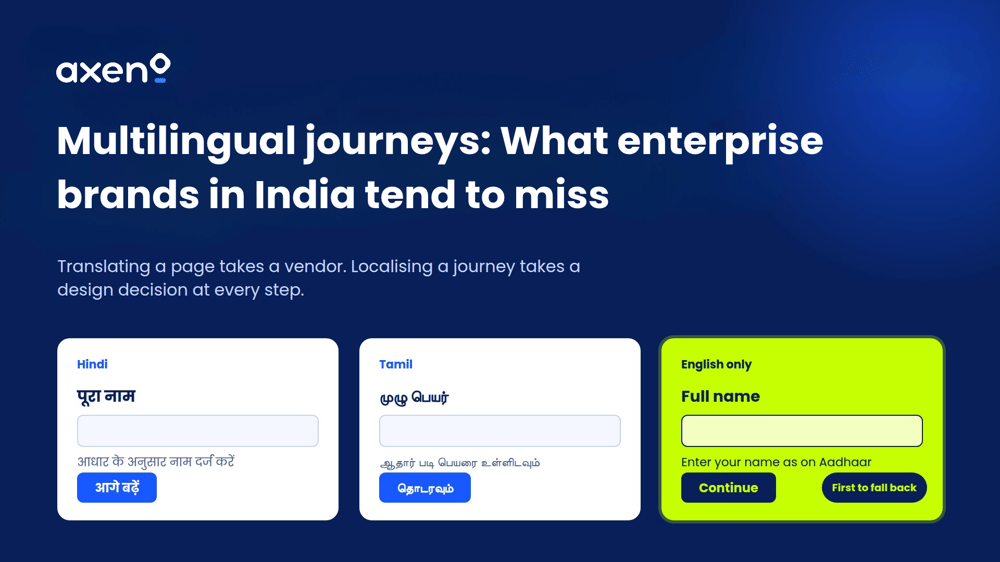
When localisation is treated as a translation task at the end of a build, the result is predictable. The homepage speaks Hindi, the product page speaks Hindi, and then the customer clicks “Apply” and lands on an English-only form. Nobody decided that. It simply fell outside the scope of the translation brief.
Customers switch languages mid-journey
A person might search in English, read reviews in English, ask a question on WhatsApp in Hindi, and sign a document in English again. Language depends on the task, the device, the person in the room and the level of trust at that moment.
This is why a language selector on the homepage is not a localisation strategy. It assumes the customer decides once, at the start. The journey has to follow the customer from step to step without making them restart each time they change language.
Where language belongs in the build
1. Content design
Localised content is written for the customer’s context, not converted from English. Sentence structure differs, so a headline that fits neatly in English may run to three lines in Tamil and break your layout. Tone differs, so a formal register that sounds trustworthy in one language can sound cold in another. Terminology differs too. Some financial, legal and technical terms are better left in English because that is how customers say them, while others need a proper local equivalent.
The practical answer is a language-aware content model from the start: flexible components, room for text expansion, fonts that render every script cleanly, and a clear rule for which terms stay in English. Content also needs an owner who reads the language fluently, not just someone who can confirm it is grammatically correct. Correct and natural are not the same thing.
2. Search and discovery
Customers search the way they speak, often in a mix of languages, sometimes in Roman script, sometimes in native script, sometimes by voice. If your discovery layer only understands English keywords, a large share of intent never reaches you. A customer who types a Hindi query into your on-site search and gets “no results found” will not retry in English. They will leave, or they will call.
Treat search as part of the journey rather than a separate SEO task. Map how customers phrase queries across languages and scripts, make sure on-site search handles mixed-language input, and build language-specific landing pages that answer the questions people actually ask instead of mirroring the English site one for one.
3. Conversational channels
Chat and WhatsApp are where language switching is most visible. Customers write the way they text their family: short, informal, and often in a blend of languages. A bot that answers casual Hindi with stiff, formal English, or one that cannot detect the language and loops back to a menu, tells the customer exactly how well the brand understands them.
Good conversational design starts with language detection and lets the customer change language at any point without losing the thread. It also needs a clean handover to a human agent who speaks the same language, with the conversation history intact. Few things frustrate a customer faster than explaining a problem in Marathi to a bot, then being asked to start again in English by the agent.
Message templates deserve attention as well. Many brands localise the first message in a WhatsApp flow and forget the reminders, follow-ups and confirmations that come after it.
4. Forms and commercial steps
This is where errors cost the most. Forms, quotes, consent screens, payment steps and terms are the moments when a customer commits money, shares personal data or accepts a binding condition. If they cannot fully understand what is on the screen, they abandon, or they call someone to ask. The second outcome quietly adds cost to every journey.
Trust is at stake too. A customer who read your product page in Tamil and then meets an English-only declaration has no way to verify what they are agreeing to. In regulated categories, that is a risk, not just an inconvenience.
At this step, good looks like:
- Field labels, hints and error messages in the customer’s language, not just the page title
- Validation messages that explain what went wrong in plain terms
- Pricing, fees and terms shown in the language the customer has been using
- Confirmation emails, SMS and receipts that match the language of the transaction
- Support options that respond in the same language
If you only have budget to localise one part of the journey deeply, make it this one.
Why journeys quietly fall back to English?
Most journeys have a point where the local language simply ends. It is rarely a conscious choice. It usually sits at a handover between systems: the CMS to the form engine, the website to the CRM, the chatbot to the agent desk, the app to the payment gateway. Each system was built or bought separately, and each has its own language settings.
The customer experiences this as a sudden shift. One moment the brand seems to understand them, the next it feels like a different company.
A simple audit finds these points. Walk the whole journey in each target language, on a mobile phone, from first search to post-purchase message. Note every place where the language changes without the customer asking for it. That list is your real localisation backlog, and it is usually longer than the team expects.
Who needs this most?
The impact is greatest in considered purchases that involve more than one person: BFSI, real estate, automotive and premium retail. In all four, the buyer researches alone and decides with others, and those others often prefer a different language. A journey that only works in English prepares you for the first conversation and leaves you unprepared for the one that closes the sale.
Where to start?
You do not need to localise everything at once. A sensible order:
- Map the journey and mark every point where customers are likely to switch language.
- Audit each point in each target language and record where it falls back to English.
- Fix the commercial steps first: forms, fees, consent and confirmations.
- Extend to conversational channels, with proper language detection and human handover.
- Rework search and content so discovery works in the customer’s own words.
- Build language into your content model and QA process so it stops being a late-stage task.
Done this way, localisation is not a cost added on top of the build. It is part of the design of the journey itself.
Frequently Asked Questions
Which languages should we start with?
Start with the languages your customers already use when they contact you or drop off. Call centre logs, WhatsApp conversations and regional sales data usually show where demand is.
Should technical or financial terms always be translated?
No. Some terms are better left in English because customers use them that way in everyday speech. Decide deliberately, term by term, and document the decision.
Does this apply outside BFSI?
Yes. It is especially relevant in real estate, automotive and premium retail, where decisions are considered and often involve family members who prefer a different language from the buyer.
Do we need to localise the entire journey from day one?
No. Begin with the steps where an error costs the most, then extend outward to conversational channels, search and content.
Find the first step where your journey falls back to English