
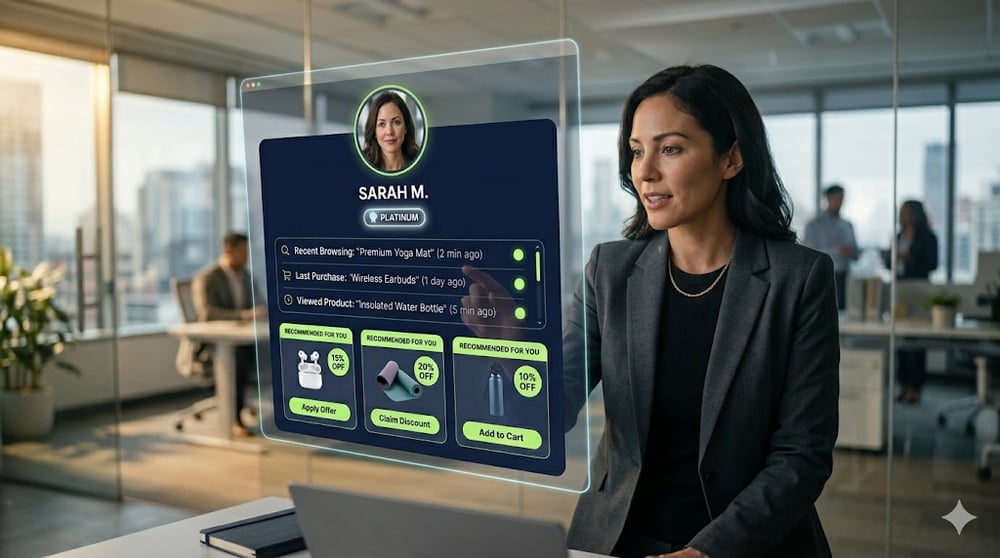
Most enterprises believe they are doing personalization. Most of their customers disagree. That gap - stubborn, expensive, and widening is the central problem of modern CX strategy.
According to Segment’s 2025 State of Personalization report, 85% of companies believe they provide personalized experiences. Only 60% of customers agree. The gap is not a technology problem. It is a deployment problem - a failure to move from the idea of personalization to the infrastructure, orchestration, and operating model that makes it real across every channel a customer touches.
The blog is not about the promise of personalization. It is about what it actually looks like when it works - drawn from over 50 enterprise deployments across automotive, financial services, insurance, and retail, delivered by Axeno's CX transformation teams over the last decade.
The Personalization Gap Is Bigger Than You Think
Let the data set the context before we get into what works.
|
89% of marketing leaders say personalization is critical to success over the next 3 years (Segment, 2025) |
35% of businesses actually achieve omnichannel personalization — not just single-channel (Contentful, 2025) |
|
71% of consumers expect personalized interactions across all touchpoints (McKinsey, 2025) |
76% are frustrated when personalization is absent from their experience (McKinsey, 2025) |
|
40% more revenue generated by personalization leaders vs slower-growing counterparts (McKinsey) |
24% of firms effectively invest in omnichannel personalization — departmental silos are the #1 barrier (Contentful) |
The most important number in that grid is 35%. A third of enterprises. Despite overwhelming investment, overwhelming intent, and overwhelming evidence that it pays off, only one in three businesses has cracked true omnichannel personalization.
The reason is almost never the technology. In over a decade of enterprise deployments, the failure modes are consistent and they are fixable.
What Enterprises Get Wrong: The 5 Failure Patterns We See Repeatedly
These are not hypothetical risks. These are patterns observed across deployments in banking, insurance, retail, and automotive, documented from project retrospectives where personalization programs delivered below expectations.
1. Channel-first thinking instead of customer-first architecture
The most common failure mode: a brand implements personalization within one channel — usually email or the website and then tries to connect channels later. It almost always fails. Each channel builds its own personalization logic on an incomplete view of the customer.
The result: the website shows one product recommendation based on browsing history, while email promotes a different product based on past purchases. The customer sees both. They experience neither as intelligent.
|
What good looks like Brands that succeed start from a unified customer data model — a single identity layer that resolves who the customer is across web, app, email, store, and CRM — before a single personalization rule is written. Personalization logic is then applied once, from the center, and executed across every channel. |
2. Underestimating data integration complexity by 50 to 70 percent
McKinsey research on enterprise personalization implementations found that most executives underestimate the data integration work required for effective omnichannel personalization by between 50 and 70 percent. What appears to be a marketing technology deployment becomes a complete customer data architecture rebuild.
The symptoms: teams launch personalization initiatives without resolving how customer identities connect across systems. Online channels use cookies. Mobile apps use device IDs. Email systems use addresses. Physical stores use loyalty card numbers. Until these are mapped to a single identity graph, all downstream personalization is operating with an incomplete picture.
|
Data point In 2026, 54% of mobile impressions and 36% of desktop impressions lack persistent identifiers (Comscore). Identity resolution is not a nice-to-have. It is the prerequisite for everything else in a personalization program. |
3. Personalization treated as a marketing project, not a CX infrastructure initiative
When personalization is owned by the marketing team alone, it gets scoped as a campaign capability - seasonal, reactive, channel-specific. When it is treated as CX infrastructure, it becomes a persistent, real-time capability that the entire organization uses.
The organizational consequence of the first approach: data science, engineering, and marketing operate in separate lanes. Each sprint delivers isolated improvements. Nothing compounds. Customer experience remains inconsistent.
The consequence of the second: a unified customer profile that marketing, service, and product teams draw from simultaneously. Personalization becomes a shared operating system, not a marketing tool.
4. Measuring the wrong things at the wrong time
A common project failure mode: a personalization program is evaluated on last-click conversion metrics within the first 90 days. These metrics will almost always disappoint early in the program lifecycle. Real personalization payoff accumulates in retention, lifetime value, and cross-channel engagement - metrics that require 6 to 12 months of unified data to measure reliably.
Teams that measure too early, on the wrong KPIs, abandon programs that would have worked. The investment disappears. The underlying data architecture degrades. The cycle repeats.
5. Technology before strategy
CDP implementations that begin with platform selection before defining the use cases they need to serve consistently underdeliver. The platform becomes the strategy - teams configure what the tool enables rather than building toward what the business needs.
The fix is sequential: use cases first, then data requirements, then platform evaluation, then implementation. In practice this is often reversed.
What Real Omnichannel Personalization Actually Looks Like
Enough on failure modes. Here is what success looks like — drawn from deployment patterns across the industries where Axeno has implemented at scale.
Across Automotive: Connected dealer and consumer journeys
The automotive buying journey spans 3 to 6 months, touches 10 to 15 digital touchpoints before a single dealer visit, and involves at least 4 channels — search, social, OEM website, and dealer CRM that historically held completely separate customer records.
In a successful deployment pattern, the first step is always identity unification: mapping anonymous web sessions, email leads, test drive requests, and dealer CRM records to a single customer profile. Once unified, personalization logic becomes genuinely useful - the customer who has viewed the same model configuration three times gets a different experience than a first-time visitor. The customer who test-drove 6 months ago and went quiet gets a retention trigger, not another top-of-funnel ad.
Measurable outcomes from this pattern: higher test drive conversion, reduced paid media waste through better suppression, and measurable improvement in repeat purchase intent among existing owners.
Across Financial Services: Real-time segmentation under compliance constraints
Personalization in financial services is not just a CX problem. It is a compliance problem. Every data activation decision must be made under consent frameworks, data residency requirements, and product-specific regulatory constraints that vary by geography and customer type.
The deployment pattern that works: a compliance-first data governance layer that defines what can be activated, to whom, and under what consent conditions - built before any personalization rule is written. The segment logic then operates within those guardrails, not around them.
What this enables: real-time segmentation based on behavioral signals (a customer checking loan eligibility three times in a week is a different customer than one who checked once), with activation triggers that comply with consent frameworks already in place. Insurance clients using this approach have seen policyholder onboarding completion improve significantly when the experience adapts in real time to where a customer drops off - rather than sending generic follow-ups 48 hours later.
|
The compliance insight Personalization and compliance are not opposites. The brands that treat consent as a data architecture requirement not a checkbox, unlock richer activation capabilities than those who retrofit it. First-party data collected under clear consent is more valuable than third-party data that requires legal review before every use. |
Across Retail: POS, app, and web stitched into one CX story
Retail is where the identity resolution problem is most acute. A single customer may have a loyalty card number, an app account, a web cookie, and a credit card on file - all under slightly different names or email addresses. Until these are resolved into one profile, every channel treats her as a different person.
The deployment pattern that delivers: unification of POS transaction data, app behavior, and web browsing into a single customer record with a loyalty ID as the anchor identifier. Once unified, the customer's in-store behavior informs online recommendations. Her app usage informs what she sees in email. Her purchase history across all channels informs what she is shown at the next in-store visit, if staff are equipped with the profile data at point of service.
The business impact of this architecture: brands using a unified customer model see overall sales improve by an average of 8.9%, and order values run up to 20% larger when personalized customer profiles are active (Shopify, 2025).
Brands with robust omnichannel engagement retain 89% of their customers. Brands with weak omnichannel engagement retain just 33% (Invesp). The 56-point gap is the cost of fragmentation.
Implementation Principles From the Field
These are not vendor recommendations. They are sequenced principles drawn from deployment patterns that have consistently worked across industries and tech stacks.
|
01 |
Start with identity, not with content Every personalization initiative should begin with a single question: can we consistently identify this customer across every channel they use? If the answer is no, content personalization will be inconsistent and often contradictory. Identity resolution infrastructure must precede personalization logic. Axeno Insight: We treat identity resolution as Phase 0 in every engagement. Nothing else runs without it. |
|
02 |
Build a unified customer profile before building segments Segment logic applied to incomplete data creates inaccurate segments. A customer who purchased in-store but has no linked online record looks like a prospect in your digital data. She is actually a loyal customer being served acquisition messaging — which damages both the experience and the budget. Axeno Insight: A single unified profile, even at 60% completeness, outperforms sophisticated segmentation applied to siloed data. |
|
03 |
Personalize the moment, not just the message The shift from batch personalization (sending the right message to the right person) to real-time personalization (changing the experience based on what the customer is doing right now) is the single biggest capability jump in modern CX. A customer checking out triggers a different experience than a customer browsing. A customer who has been inactive for 45 days requires a different signal than one who visited yesterday. Axeno Insight: Real-time event-triggered personalization consistently outperforms scheduled campaign logic. In our deployments, trigger-based journeys have delivered 2 to 4x the engagement of equivalent batch campaigns. |
|
04 |
Treat consent as a data asset, not a legal requirement Brands that collect consent signals as structured data — not just as compliance documentation — can activate personalization capabilities that are completely unavailable to competitors relying on third-party data. Zero-party data (preferences the customer deliberately shares) and first-party behavioral data collected under clear consent are the most durable personalization inputs available in a cookieless environment. Axeno Insight: 81% of consumers believe how a brand handles their data reflects how it views them as customers (MoEngage). Consent-driven personalization is both a trust signal and a data advantage. |
|
05 |
Define measurement frameworks before going live The KPIs used to evaluate a personalization program should be defined at program design — not retroactively. Retention rate, customer lifetime value, cross-sell conversion, and channel engagement depth are the right long-term metrics. Early-program measurement should focus on data quality scores, identity resolution rates, and segment accuracy — not revenue metrics that require 12 months of unified data to be meaningful. Axeno Insight: Programs killed for 'underperformance' in the first quarter are almost always measuring the wrong thing at the wrong time. |
|
06 |
Cross-functional ownership is not optional A personalization program owned only by marketing will deliver marketing-scoped outcomes. A program with shared ownership across marketing, product, engineering, and service will deliver customer-scoped outcomes — which is the only kind that compounds over time. The organizational model must match the ambition of the initiative. Axeno Insight: In our most successful deployments, there is a named CX lead with budget authority who sits above the individual channel teams. This is not a committee. It is a decision-maker. |
|
07 |
Phase the capability, not the ambition The brands that stall on personalization are usually those that designed a comprehensive future state and tried to implement it all at once. The brands that succeed scope aggressively for the first 90 days — typically one use case, one channel, full stack — prove the value, and then expand. The architecture is designed for scale from day one. The deployment is not. Axeno Insight: Start narrow enough to win fast. Win fast enough to earn the mandate to scale. |
What Separates the 35% Who Get It Right
The brands delivering real omnichannel personalization share a small number of structural characteristics that consistently separate them from the majority.
- They have resolved customer identity across at least three channels before attempting personalization at scale.
- They have a consent and data governance framework that enables activation, not one that simply restricts it.
- They have defined personalization as a cross-functional capability - not a marketing campaign feature.
- They measure long-term retention and lifetime value outcomes, not just campaign-level conversion.
- They have deployed in phases, with clear success criteria at each phase gate before expanding scope.
- They treat their customer data platform as living infrastructure - maintained, monitored, and iterated not as a one-time implementation project.
The common thread is not the technology stack. We have delivered these outcomes across multiple platforms, across different maturity levels, and at significantly different budget scales. The common thread is the operating model, the way the program is structured, sequenced, and governed.
A Final Word on the Practitioner Gap
There is no shortage of personalization content on the internet. There is a significant shortage of content written by people who have actually implemented personalization programs at enterprise scale, managed the identity resolution failures, debugged the consent architecture, and recalibrated measurement frameworks mid-program when early KPIs pointed the wrong direction.
The lessons in this post come from that experience — across automotive, financial services, insurance, and retail, across geographies, and across different technology stacks. The through-line is not the platform. The through-line is the operating model: how the capability is designed, sequenced, governed, and measured.
If your organization is planning a personalization initiative or trying to understand why a current initiative is underperforming - the patterns above are where to start the diagnosis.
Not sure where your personalization program is breaking down?
Axeno’s CX Readiness Assessment pinpoints exactly where in 45 minutes, at no cost.Omnichannel Personalization for Enterprise Teams
Frequently Asked Questions
What is the difference between multichannel and omnichannel personalization?
Multichannel means the brand is present across multiple channels — email, web, app, store. Omnichannel means those channels share data and respond to each other. A multichannel brand sends an email and shows a website banner. An omnichannel brand sends an email based on what you did on the app this morning, and updates the website banner in real time when you click through. The difference is data integration and real-time orchestration.
.
How long does it take to implement omnichannel personalization at enterprise scale?
A meaningful first use case - one channel, unified data, real-time triggers can be live in 10 to 16 weeks with the right team and data access. A full omnichannel architecture with 5 or more active channels, comprehensive identity resolution, and advanced segmentation typically requires 12 to 18 months of phased delivery. Brands that try to compress this timeline without phasing correctly almost always pay the cost in rework.
What data do we need before starting a personalization program?
The minimum viable data set for personalization: a reliable customer identifier (email, loyalty ID, or login), behavioral event data from at least one digital channel, and a structured transaction history. Identity resolution requires connecting at least two of the following: email address, phone number, device ID, loyalty card number, or cookie ID. Programs that attempt to personalize before establishing identity resolution produce inconsistent results and damage trust.
Is omnichannel personalization only for large enterprises?
No — but the approach scales with organizational complexity. A brand with two channels and a clean CRM can implement effective personalization in weeks. An enterprise brand with 8 channels, regional compliance requirements, and millions of anonymous profiles requires a significantly longer foundation phase. The principles are the same. The infrastructure investment scales with the data complexity.
What is hyper-personalization, and how is it different from personalization?
Standard personalization uses segment-level logic: customers in this cohort get this experience. Hyper-personalization uses individual-level behavioral signals in real time: this specific customer, based on what they are doing right now, in this context, gets this experience. Hyper-personalization requires a real-time event processing capability, a unified customer profile, and decisioning logic that runs in milliseconds. It is meaningfully harder to implement — and meaningfully more effective when deployed correctly.
-1.png)