
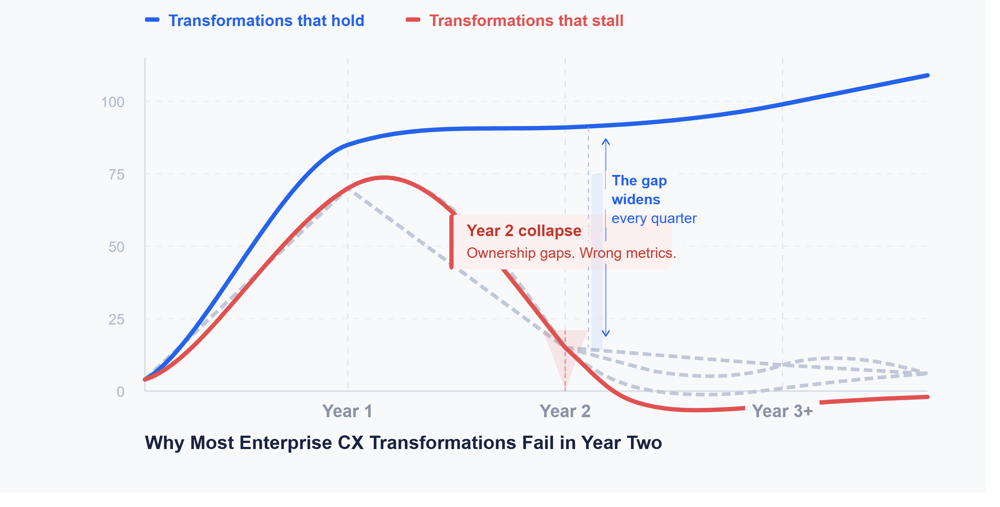
Most enterprise CX transformation programmes do not collapse at launch. They collapse quietly, somewhere between month fourteen and month twenty-two, long after the press release has been forgotten, and the steering committee has moved on to the next priority.
The symptoms are familiar: teams revert to legacy processes, adoption of metrics plateau, the business case gets harder to defend, and momentum drains out of the programmed before it ever reaches scale. Leadership calls it an implementation problem. In most cases, it is not.
After working across complex CX transformation engagements, a consistent pattern becomes clear. Year-one failure is rare because organizations are in launch mode. Budgets are protected, executive attention is high, and ambition is treated as a strategy. Year two is where the architecture of a transformation either holds or buckles. The organizations that reach year three with genuine traction did not get lucky. They made different structural decisions from the start.
This piece identifies the most common failure modes and, more usefully, what the organizations that beat the odds actually do.
The Year-Two Problem
Year one of a CX transformation is engineered for momentum. There is a defined scope, a named executive sponsor, implementation partners on-site, and quarterly milestones the board can see. The organization is running on belief.
Year two is different. The implementation partner has handed over to internal teams that may not yet have the capability to sustain what was built. The executive sponsor has competing priorities. The budget that was ring-fenced for transformation is now being scrutinized against operational results that are still mixed. And the technology that was deployed is only as effective as the people and processes built around it.
This is the moment most programme quietly begin to degrade. Not because the strategy was wrong. Because the conditions required to sustain the strategy were never put in place.
The Six Most Common Failure Modes
1. Strategy Built Around the Launch, Not the Lifecycle
Most CX transformation strategies are written to justify an investment decision. They define what will be built, what it will cost, and what the business outcomes will be at the end of year one. Very few of them define what the organisation needs to look like in year three to sustain those outcomes.
This is not a planning failure. It is an incentive failure. The people who build the business case are rewarded for securing the investment, not for the long-term performance of the programme. The result is a strategy that optimises for approval, not for durability.
Organisations that avoid this pattern commission a separate sustainability review before implementation begins. They ask the uncomfortable question: if the transformation delivers exactly what we have planned, what does the organisation need to be capable of in order to maintain it? The answer to that question becomes part of the programme, not an afterthought.
2. Ownership Sitting in the Wrong Function
CX transformation is frequently owned by technology or IT, because the most visible deliverables are technology platforms. When ownership sits there, the transformation is measured on deployment milestones, not customer outcomes. The business units that own the customer relationship are treated as stakeholders rather than co-owners.
The consequence is predictable. The technology gets deployed, and then sits underused because the people closest to the customer did not shape it, do not trust it, and were never given the operating model to embed it into their daily work.
The organisations that sustain transformation tend to place ownership in a cross-functional structure with genuine authority. Technology, marketing, operations, and commercial leadership are all represented, and the person accountable for the programme has a mandate that spans all of them.
The organisations that sustain CX transformation are not the ones that deployed the most technology. They are the ones that changed how the business makes decisions about customers.
3. Measurement Frameworks That Reward the Wrong Behaviour
Most CX transformations are measured on channel adoption, campaign throughput, and platform utilisation. These are activity metrics. They tell you whether the technology is being used, not whether it is creating value for customers or the business.
When teams are measured on activity, they optimise for activity. More emails sent, more journeys triggered, more personalisation rules configured. The underlying customer experience may be deteriorating at the same time, and the measurement framework will not surface it.
Sustainable programmes are built on outcome metrics tied directly to business performance: customer retention rates, revenue per customer segment, net promoter scores correlated with commercial behaviour, and cost-to-serve ratios. These are harder to measure, take longer to move, and require cross-functional data access. But they are the only metrics that tell you whether the transformation is actually working.
4. Capability Investment That Stops at Go-Live
Training a team to operate a new technology platform at the point of launch is not capability building. It is onboarding. The two are frequently confused.
By year two, the people who were trained at launch have moved on, the business requirements have evolved, and the platform capabilities have expanded beyond what the original training covered. Without a structured approach to ongoing capability development, the organisation's ability to use the technology degrades every quarter.
The organisations that close this gap treat capability development as a continuous programme, not an implementation phase. They create internal roles dedicated to platform expertise, theyinvest in communities of practice across the teams using the technology, and they build formal pathways for upskilling as the platform evolves.
5. Data Infrastructure That Cannot Support the Vision
Every enterprise CX transformation vision involves personalisation at scale, real-time decision-making, and a unified view of the customer. Almost none of them begin with an honest assessment of whether the organisation's current data infrastructure can support any of those things.
The gap between the transformation vision and the data reality is usually discovered in year two, when the use cases that were promised at launch fail to perform because the data required to run them is incomplete, inconsistent, or inaccessible.
The organisations that avoid this failure conduct a rigorous data readiness assessment before any platform selection begins. They define the specific data requirements of each use case, audit their current data estate against those requirements, and build the gap remediation into the programme scope and timeline.
6. Change Management Treated as Communication
Change management is the most consistently underinvested element of enterprise CX transformation. In most programmes, it consists of a launch email from the CEO, a training session, and a change champion network that has no real mandate or support.
When change management is this thin, the transformation is dependent on individual motivation. The people who were enthusiastic about the programme at launch will carry it for a while. The people who were sceptical will wait for it to fail, and their patience is usually rewarded.
Real change management in a CX transformation requires a structured assessment of the behaviour changes required across every affected role, a programme of interventions designed to shift those behaviours, and a governance mechanism that tracks and responds to resistance as it emerges. It is a significant investment, and it is the one that most frequently gets cut in budget negotiations.
What Successful Transformations Do Differently
The organisations that sustain CX transformation beyond year two share a set of structural choices that are visible from the start of the programme. These are not silver-bullet answers. They are disciplines that require consistent investment and leadership attention. But they are identifiable, replicable, and they make a material difference to outcomes.
They Define What Success Looks Like in Year Three Before They Invest in Year One
The most durable transformations begin with a five-year operating model question, not a technology selection question. Before any platform is chosen, the organisation defines what the business needs to be capable of in the long term, what the customer experience should feel like at maturity, and what the internal operating model needs to look like to sustain it. Technology selection follows that definition. It does not precede it.
They Build Internal Authority, Not Just External Partnership
They invest heavily in developing an internal centre of capability that can sustain the transformation beyond the initial implementation period. This is not about headcount. It is about creating people with genuine depth in the platforms and processes that underpin the programme, and giving them the authority and resources to shape how those platforms evolve over time.
They Measure What Matters to the Business, Not What the Platform Makes Easy to Report
They resist the pull towards activity metrics and build measurement frameworks that connect CX performance directly to business outcomes. This requires investment in data infrastructure and cross-functional reporting, but it is the foundation of a business case that survives year-two budget scrutiny.
They Treat Change Management as a Capability Programme, Not a Communication Plan
They invest in understanding the specific behaviour changes required at each level of the organisation, and they build interventions designed to drive those changes over time. They create governance mechanisms that surface resistance early, and they have a plan for responding to it.
They Architect for Evolution, Not Just for the Current Requirements
They build technology and operating model architectures that are designed to change as business requirements evolve. They avoid deep customisation that creates technical debt, they invest in integration standards that allow the technology landscape to flex over time, and they build regular review mechanisms that assess whether the architecture is still fit for purpose.
The Question Worth Asking Now
If your organisation is in year one of a CX transformation, the most valuable thing you can do is not optimise for the launch milestone. It is to stress-test the programme against year-two conditions today.
Ask whether the ownership structure will hold when executive attention moves on. Ask whether the measurement framework will give you a defensible business case when the budget is under pressure. Ask whether the capability investment plan will leave the organisation better able to operate the programme in eighteen months than it is today.
If the answers are unclear, that is the work. Not the technology. Not the campaign calendar. The structural conditions that determine whether the transformation holds.
Year-two failure is not inevitable. It is the predictable consequence of decisions made, or not made, in year one. The organisations that understand this have a significant advantage.
Ready to Build a Transformation That Hold
YOU MAY NEED TO KNOW
Frequently Asked Questions
Why do so many enterprise CX transformations fail?
The most common reason is that transformation programmes are designed to succeed at launch, not to sustain over time. Year one runs on protected budgets, executive attention, and implementation of energy. When those conditions normalise in year two, programmes that were not built for durability begin to degrade. Ownership gaps, weak measurement frameworks, underdeveloped internal capability, and change management treated as a communication exercise are the recurring structural causes.
What is the biggest mistake organisations make when planning a CX transformation?
Starting with technology selection rather than operating model design. Platform decisions are made before the organisation has defined what long-term success looks like, what internal capabilities need to exist at maturity, or whether the data estate can support the use cases being promised. Technology chosen ahead of strategy creates constraints that become very expensive to undo.
How should CX transformation ROI be measured at the enterprise level?
CX transformation ROI should be anchored to business outcomes rather than platform activity. The metrics that matter are customer retention rates by segment, revenue per customer over time, the correlation between customer experience scores and commercial behaviour, and cost-to-serve ratios across channels. Activity metrics such as email volume, campaign throughput, or journey completion rates indicate whether the technology is being used, not whether it is generating value.
Which function should own enterprise CX transformation?
No single function should own it in isolation. When CX transformation sits solely within technology or IT, it gets measured on deployment milestones rather than customer outcomes. When it sits solely within marketing, data and operational dependencies are often underestimated. The most effective ownership model is a cross-functional structure with genuine authority spanning technology, marketing, operations, and commercial leadership, led by someone with a mandate that crosses all of them.
How long does a successful enterprise CX transformation take?
Meaningful CX transformation at enterprise scale typically requires three to five years to reach genuine maturity. Year one establishes the platform and operating model foundations. Year two is where the programme is tested against real-world conditions and leadership attention is no longer exclusively focused on it. Years three to five are where compounding returns become visible, provided the right structural decisions were made at the outset. Organisations that expect transformation to be complete at the end of a twelve-month implementation are usually disappointed by year two.
What role does data readiness play in CX transformation success?
Data readiness is one of the most consistently underestimated factors. Transformation visions that promise personalisation at scale and real-time customer decisioning require a data infrastructure capable of supporting those use cases. Most enterprise organisations discover the gap between that vision and their actual data estate in year two, when the use cases they planned at launch fail to perform. A rigorous data readiness assessment conducted before platform selection begins is one of the clearest differentiators between programmes that sustain and those that stall.
How do you get CX transformation back on track after early signs of stall?
Start with a structured diagnostic that separates symptoms from causes. Declining adoption is a symptom. The cause is usually one of the six structural failure modes described above. Once the root cause is identified, recovery typically requires resetting ownership accountability, rebuilding the measurement framework around outcomes rather than activity, and investing in the capability gaps that have opened up since go-live. Recovery is possible, but it requires the same honest structural assessment that should have happened at the start of the programme.
-1.png)